What Is a Plasma Cutter and How Does It Cut Conductive Metals?
Industrial cutting has changed dramatically as shops demand faster output and tighter tolerances. Plasma technology stands out because it blends electrical energy with controlled heat to slice metal efficiently. Understanding how a plasma cutter works helps explain why it has become a staple across fabrication floors and advanced CNC environments.
Understanding What a Plasma Cutter Is and Where It’s Used
A plasma cutter is a thermal cutting tool that uses an electrically charged stream of gas to cut through conductive metals. It is widely used for steel, stainless steel, aluminum, brass, and copper because these materials respond well to electrical conductivity. Fabrication shops, repair facilities, and CNC companies near me rely on plasma cutting for speed and flexibility. Usage varies from handheld cutting for maintenance work to automated tables in large-scale production. A CNC plasma cutter allows repeatable, precise cuts for parts that must match digital designs. Many operations turn to a CNC machine company when accuracy, volume, and integration with automation are required.
What Are the Main Parts Inside a Plasma Cutting System
A plasma cutting system includes a power supply, torch, gas supply, consumables, and grounding clamp. The power supply generates the electrical arc, while the torch directs the plasma stream toward the metal. Consumables such as electrodes and nozzles shape and stabilize the arc during cutting.
Supporting components play a key role in performance. Gas regulators control pressure and flow, while grounding completes the electrical path. In a CNC plasma cutting machine, motion systems and controllers add another layer, synchronizing torch movement with power output for clean, consistent cuts.
How Plasma Turns Compressed Gas into a Cutting Arc
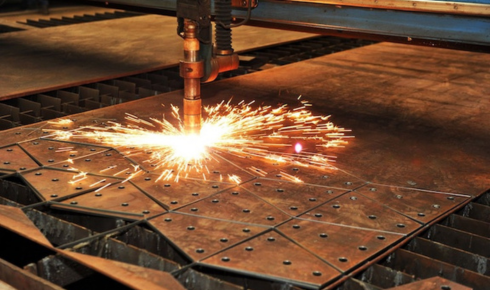
The cutting process begins when compressed gas flows through the torch. An electrical current energizes the gas, transforming it into plasma—a superheated, ionized state capable of conducting electricity. This plasma exits the nozzle as a focused jet.
As the arc contacts the metal, temperatures rise rapidly, often exceeding 20,000 degrees Fahrenheit. The intense heat melts the metal, while the gas stream blows molten material away from the cut. This combination of heat and velocity allows a plasma cutter to move quickly without physical contact.
Why Conductive Metals Respond to Plasma Cutting
Conductivity is essential because plasma cutting relies on electrical flow through the workpiece. Metals such as carbon steel and aluminum allow current to pass easily, completing the circuit between the torch and ground clamp. This electrical path sustains the arc.
Non-conductive materials cannot support this process. That limitation explains why plasma cutting is restricted to certain metals. For shops evaluating cutting options, understanding conductivity helps determine whether a plasma cutter or another method is appropriate.
When Plasma Cutting Works Better than Oxy-fuel Methods
Plasma cutting excels on thinner materials and non-ferrous metals where oxy-fuel struggles. It cuts faster, produces less heat distortion, and does not rely on oxidation. This makes it ideal for aluminum and stainless steel applications.
Oxy-fuel still has advantages on very thick carbon steel, but plasma offers greater versatility. A CNC plasma cutter can switch materials with minimal setup changes, which improves workflow efficiency in mixed-production environments.
How Electrical Current Completes the Cutting Circuit
Electrical current flows from the power supply through the torch, into the plasma arc, and then through the metal to the ground clamp. This closed loop keeps the arc stable and focused. Without proper grounding, the arc becomes inconsistent and cut quality suffers.
In automated systems, grounding is engineered carefully to support high-speed cutting. CNC plasma cutting machines depend on stable electrical paths to maintain accuracy during long production runs.
Understanding Heat Transfer at the Metal Edge
Heat transfer plays a major role in cut quality. Plasma delivers concentrated heat to a small area, reducing the heat-affected zone. This minimizes warping and preserves material properties near the cut edge.
The speed of the cut influences heat buildup. Faster movement reduces excess heat, while slower speeds increase penetration. Skilled operators and CNC systems balance speed and power to achieve smooth edges with minimal slag.
What Are the Limits Based on Metal Thickness
Every plasma cutter has thickness limits based on power output and design. Lower-amperage systems handle thin sheet metal, while industrial units cut plate several inches thick. Exceeding these limits results in poor edge quality and incomplete cuts.
CNC plasma cutting machines are often selected based on maximum thickness requirements. A CNC machine company evaluates material type, thickness range, and production goals before recommending system specifications.
How Torch Movement Controls Cut Quality and Speed
Torch movement determines how evenly heat is applied along the cut path. Steady motion prevents dross buildup and ensures uniform kerf width. In manual cutting, operator skill influences results.
Automated systems remove variability. A CNC plasma cutter controls torch height, speed, and direction precisely, producing repeatable results across thousands of parts. This consistency is a key reason many manufacturers turn to CNC companies near me for plasma solutions.
Plasma cutting combines electrical science with mechanical precision to deliver fast, clean cuts on conductive metals. Amtec Solutions Group supports manufacturers by designing and integrating plasma cutting systems, CNC automation, and engineered solutions that improve accuracy, efficiency, and production capability across diverse industrial applications.