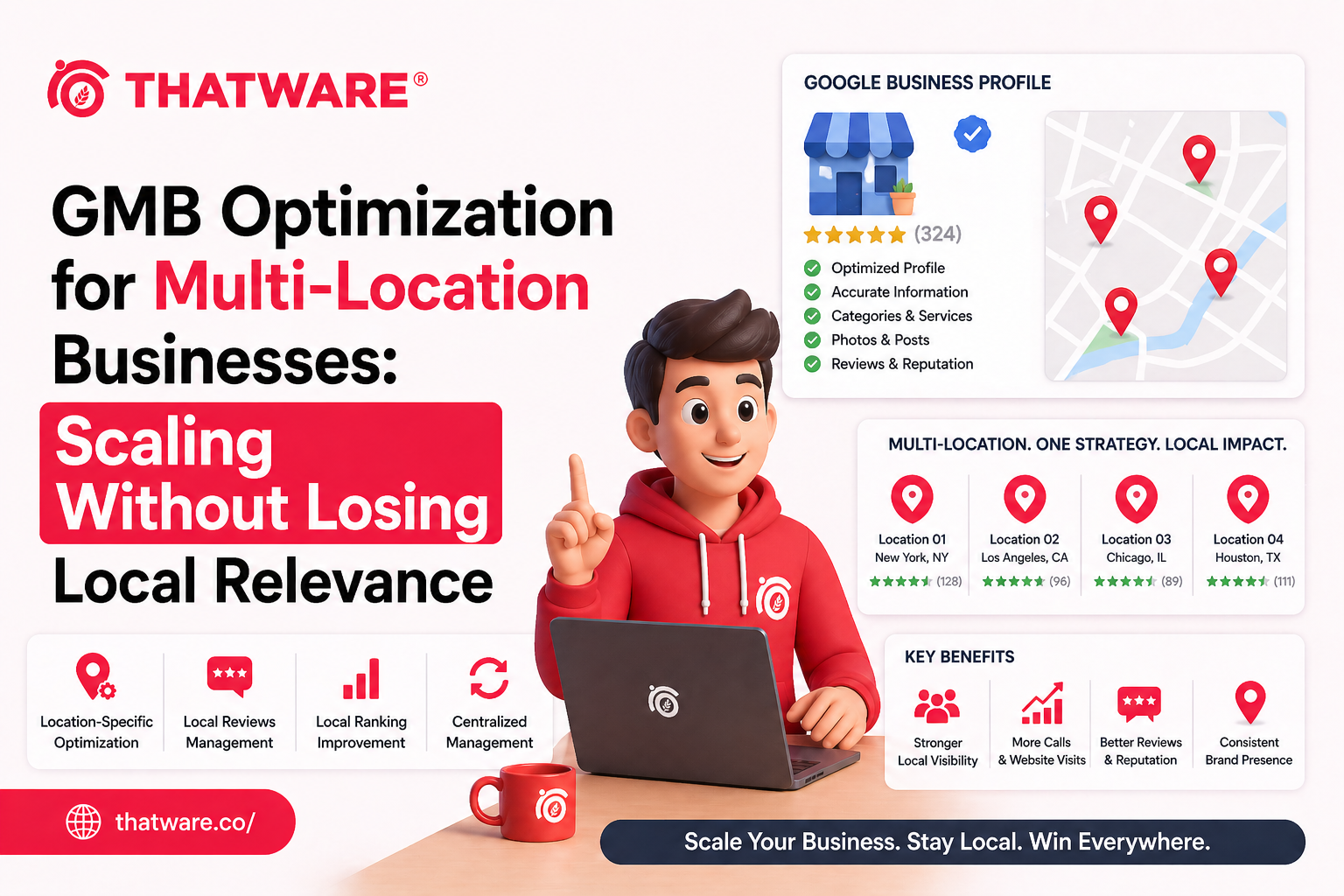
Managing a single Google Business Profile is straightforward enough that most business owners can handle it themselves. Managing 50, 150, or 500 of them — keeping the information accurate, the reviews responded to, the local content relevant, and the overall profile health strong across every location — is an operational and strategic challenge that most businesses underestimate when they start scaling. The right gmb optimization services approach for a multi-location business isn’t just about doing what you’d do for one location, repeated. It’s about building scalable systems that maintain local relevance without requiring manual effort at every location. And the local seo services that understand this distinction are genuinely different from the ones offering templated optimization at scale.
Here’s what actually works.
Why Multi-Location GMB Is a Different Problem
The reason multi-location Google Business Profile management is hard is that it sits at the intersection of two things that don’t naturally coexist: scale efficiency and local authenticity.
Google’s local ranking algorithm rewards signals that are genuinely local. A Business Profile that has locally relevant posts, photos that reflect the actual physical location, reviews that reference local staff members by name, and a description that speaks to the specific neighborhood or community performs better than a profile that’s clearly been templated from a master document and pushed out uniformly across hundreds of locations.
But producing genuinely local content at scale is expensive. Having someone create custom photos, write location-specific posts, and respond to reviews with genuine local context for 300 locations every month requires significant resource allocation that most businesses can’t sustain indefinitely.
The answer is building systems that provide local authenticity at reasonable cost — not perfect individualization, but meaningful differentiation from generic templating.
The Data Foundation: Getting the Basics Right at Scale
Before any optimization, the data needs to be right. Name, address, phone, hours, website, categories — these need to be accurate and consistent across every location, across every platform that influences local search: Google, Apple Maps, Bing Places, Yelp, and the dozens of data aggregators that feed local search databases.
For businesses with dozens or hundreds of locations, this requires using a location data management platform — Yext, Uberall, Brightlocal, or similar — to push consistent information across directories from a single source of truth. Manual management at this scale is both time-consuming and error-prone, and inconsistent data creates local ranking signals that work against you.
Getting the category selection right matters more than most businesses realize. The primary category is one of the strongest local ranking factors, and the secondary categories should be chosen to capture the full range of relevant searches at each location without going so broad that they dilute relevance. This requires location-by-location consideration, not uniform assignment.
Review Management at Scale
Reviews are the most powerful local ranking factor and also the most operationally intensive to manage properly at scale.
Review velocity matters. Profiles that receive consistent review volume over time outperform those that receive spikes followed by silence. Building review generation into customer-facing workflows — service completion emails, post-visit SMS, in-location NFC tap prompts — creates consistent velocity without requiring ongoing manual effort per location.
Response strategy matters too. Not just responding to negative reviews, but responding to all reviews in ways that feel genuine rather than templated. Generic “thanks for your feedback” responses at scale are detectable by sophisticated users and may not provide the engagement signal that location-specific responses do.
For large businesses, a tiered response approach works well: templated-but-customized responses for routine positive reviews, escalation protocols for negative reviews that require genuine engagement, and manual priority attention for high-profile or detailed reviews that deserve substantive responses.
Local Content at Scale
The GMB post function is underutilized by most multi-location businesses, which creates a meaningful opportunity for those willing to invest in a local content program.
The approach that works at scale: a content calendar at the national or regional level that provides themes, promotions, and seasonal messaging, combined with local adaptation layers that allow individual locations (or regional managers) to add location-specific elements. A post about a seasonal promotion might go out uniformly across all locations with a localized photo from that specific location. A product launch post might have location-specific details about which products are in stock at which locations.
This hybrid approach delivers more local relevance than pure templating while being significantly more scalable than fully individualized content production.
Monitoring and Reporting Across the Portfolio
With a large location portfolio, you can’t personally monitor every profile for spam, unauthorized edits, or performance changes. Automated monitoring for profile changes, review alerts, and ranking fluctuations across locations is the operational baseline.
Reporting should surface both aggregate portfolio health and location-specific outliers — the locations with declining review scores, the profiles that have received unauthorized edits, the locations where local pack visibility is underperforming the cluster average. These outliers often represent the most actionable optimization opportunities in a large portfolio, and finding them requires systems rather than manual auditing.
Done properly, multi-location local seo services management is a genuine competitive moat. Most businesses do it poorly enough that consistent, systematic execution creates advantages that compound over time.